SHIPPING CONTAINER DELIVERY GUIDELINES
Before purchasing a shipping container, make sure you have enough space for a smooth roll-off delivery. Our delivery guidelines outline the minimum requirements to help you prepare properly.
WHAT TO AVOID FOR A STRESS-FREE DELIVERY?
ROUGH ROADS
Dirt, gravel, or damaged roads may not be suitable for shipping container delivery. Weight limits and poor conditions can cause vehicles to get stuck, damage the road or equipment, and create environmental hazards.
STEEP ROAD INCLINES AND DECLINES
Steep inclines can make hauling a container uphill impossible, while steep declines may create safety risks for the delivery crew and the surrounding area. Contact us for an evaluation of your delivery route to ensure your local road grades are suitable for a successful container delivery.
TIGHT TURNS
Shipping containers need enough turning clearance to ensure safe delivery and prevent getting stuck or causing damage. A 20ft container requires at least 60ft of straight-line clearance, while a 40ft container needs at least 125ft. Narrow rural roads with trees or ditches, as well as crowded urban streets with buildings or parked cars, can make container delivery impractical.
HEIGHT RESTRICTIONS SUCH AS OVERHANGING TREES, POWER LINES, AND LOW BRIDGES
Any obstacle with less than 14ft of vertical clearance is considered a height restriction for shipping container delivery. This can include power lines, trees and branches, gateways, arches, building eaves, and low bridges. Ensuring adequate vertical clearance along your entire delivery route is essential to avoid hazards and delays.
WIDTH RESTRICTIONS
Shipping containers need at least 14ft of horizontal clearance to pass safely without getting stuck or causing delays. Narrow roads under 14ft may prevent delivery, and if no alternative route exists, the delivery could be canceled. Ideally, access roads to your location should be at least standard two-lane roads.
WEATHER-AFFECTED ROADWAYS
Roads impacted by weather can make shipping container delivery unsafe or impractical. This includes icy, flooded, or muddy roads, roads covered with debris after storms, and snowy roads that haven’t been plowed. We’re happy to help customers plan their delivery to fit their schedule while ensuring a safe, hassle-free process. Unsure if your local roads can handle a shipping container delivery? Contact us for a free delivery guideline assessment and review of your roads and surroundings before ordering from America Conex.
TILT BED SHIPPING CONTAINER DELIVERY
Tilt-bed trailers are specifically designed to safely deliver shipping containers, allowing for direct placement on the ground at the drop-off site.
Tilt-bed trailers are ideal for small businesses, private properties, and other locations without specialized forklifts or cranes to move containers. When using a tilt-bed trailer, delivery planning must consider the placement location,
available space, and ground conditions. Since the container cannot be moved once placed without equipment, it’s crucial to ensure the surface is suitable for storage.
America Conex works with you to determine if tilt-bed delivery meets your needs. Tilt beds can transport both 20ft and 40ft shipping containers. This method requires at least 125ft of straight-line clearance, as the trailer is pulled out
from underneath the container. You’ll also need to choose the door orientation prior to delivery, as it affects how the container is loaded onto the trailer.
FLATBED SHIPPING CONTAINER DELIVERY
Unlike tilt-bed trailers, flatbed trailers do not have a built-in off-loading feature. Containers delivered on a flatbed must be off-loaded manually using a crane, forklift, or other heavy lifting equipment. Flatbed delivery is best suited for business locations or properties that already have the necessary lifting equipment on site. Since you are responsible for off-loading, preparing the drop-off location is generally simpler compared to tilt-bed deliveries.
SHIPPING CONTAINER DELIVERY SPACE CLEARANCE
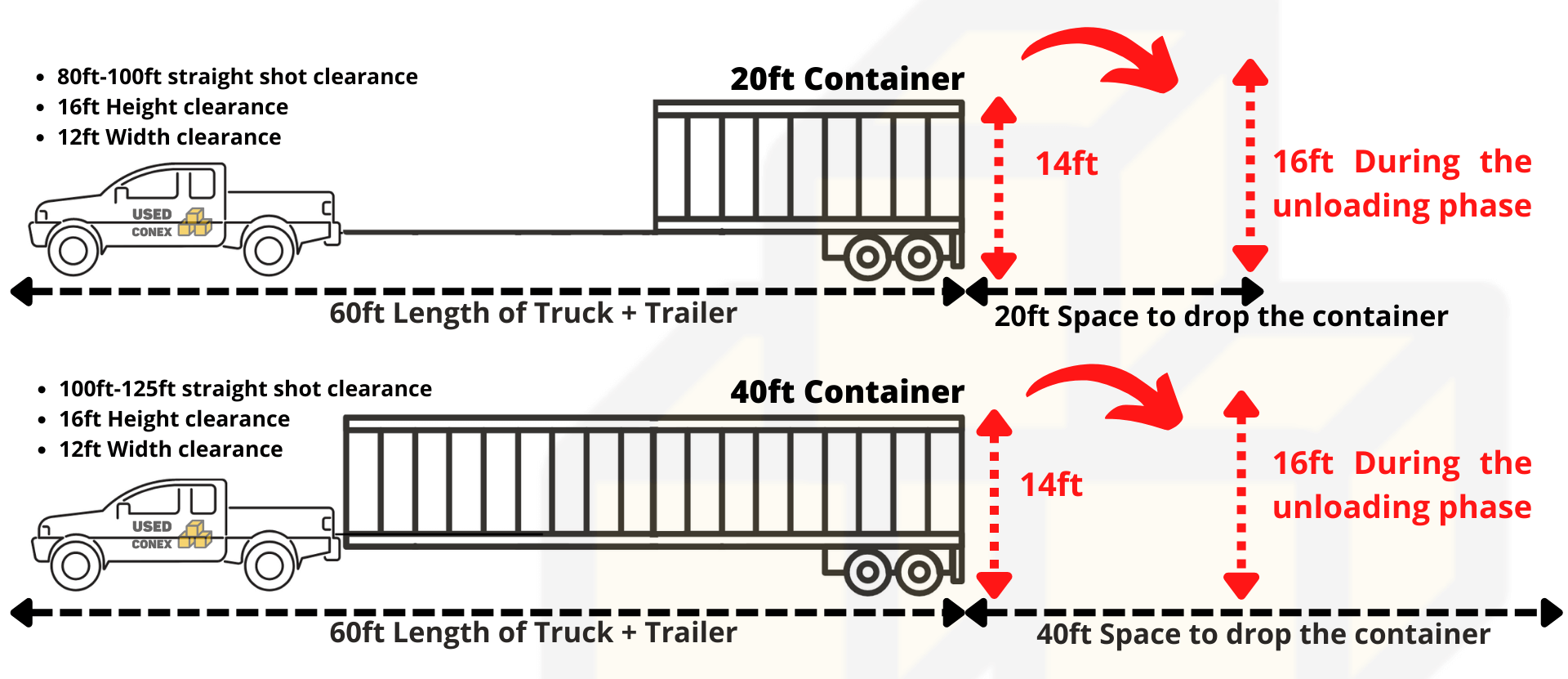
Before buying new or used shipping containers, it’s important to ensure the drop-off site is adequately equipped to accommodate a container delivery. This includes having enough space to store a 20ft container or a 40ft container
and enough area for delivery vehicles and other equipment to perform their duties safely and securely. You’ll also need to ensure that any limited-access locations have minimum height and width clearance for the truck, trailer, and shipping
container before placing your order. Roads leading to your business location or private property will also need to accommodate truck and trailer clearance. They must be suited for heavy vehicles regarding road weight limits, road conditions,
road grades, overhanging objects, and turning radiuses.
At America Conex, we’re here to help you prevent any delays or setbacks in your shipping container goals by being fully prepared ahead of time. From consultation to site inspection, we offer a range of services to help you determine the optimal site and
schedule for your storage container delivery.
A SPECIFIC MINIMUM CLEARANCE IS REQUIRED:
20FT SHIPPING CONTAINER
40FT SHIPPING CONTAINER
SHIPPING CONTAINER DROP SITE PREPARATION
Avoid Difficulties and Delays by Preparing for Shipping Container Delivery with this Simple Checklist.
A big part of the work involved with shipping container drop-offs is being prepared. When your location is well-suited for drop-offs, storage,
or transfer of shipping containers, the process can be completed in just 1 hour or less. Having a suitable drop site will also ensure that the
container is not damaged or compromised during storage. It also makes its removal much more efficient in the case of future transfers, alternative uses, and resale.
Here’s what to consider before ordering a shipping container to help save time and avoid safety risks, equipment damage, or delivery cancellation.
SHORT-TERM OR LONG-TERM SITE PREPARATION?
Depending on your goals, your site may require short-term or long-term container storage preparation. Long-term storage or permanent use typically requires additional steps to ensure the container is not damaged or compromised over time while being conducive to your goals. Please get in touch for more information on the difference between long-term and short-term site preparation.
DELIVERY VEHICLE & TRAILER CLEARANCE
Drop sites without sufficient clearance can make it difficult or impossible to perform container drop-offs. For successful delivery and future logistics, ensure that your drop site offers enough clearance to maneuver the vehicle, trailer, and shipping container into place. Learn more about shipping container delivery clearance.
LEVEL GROUND
The drop site and surrounding area should be on level ground to ensure secure delivery vehicle access and container placement. It is also necessary to create even weight distribution across all
four corners of the shipping container. Land that is not level can make it difficult for delivery vehicles to get into position and lead to container damage due to uneven weight distribution resulting in pinched doors, bent corners, and other defects.
If the ground is not naturally-level, it can be modified with stone pavers, blocks of wood, gravel, or railroad ties under the corners to create even weight distribution.
DROP SITE GROUND SURFACES
Shipping containers can be dropped off on any surface that is firm, level, and dry. Drop sites will ideally have an asphalt or concrete space prepared for shipping container drop-off. However, surfaces such as compact dirt, gravel, and even grass may be suitable — provided that they are level, safe from weather, and offer even weight distribution and support. This will ensure that the shipping container does not sink or move when in position. Surfaces such as sand, soft dirt and muddy grounds are not recommended as it may result in container shifting, sinking and damage.
DROP SITE IS FREE OF DEBRIS AND OBSTACLES
Make sure your storage container drop site is free of rocks, tree stumps, branches, or any debris that can cause an inconvenience or equipment damage during your storage container drop off.
DROP SITE IS FREE OF SAFETY HAZARDS
Apart from sufficient vertical and horizontal clearance, the drop site should also be free of any safety hazards such as low-hanging wires, cables, branches, and equipment that may pose risks during drop off. In the case of limited visibility, crews can rely on spotters to help them navigate the vehicles and container into position.
DROP SITE IS FREE OF SAFETY HAZARDS
Apart from sufficient vertical and horizontal clearance, the drop site should also be free of any safety hazards such as low-hanging wires, cables, branches, and equipment that may pose risks during drop off. In the case of limited visibility, crews can rely on spotters to help them navigate the vehicles and container into position.
WEATHER CONDITIONS
From transportation to drop-off, a big part of successful delivery is keeping ground surface conditions in mind. To prevent difficulties and delays, it’s important to plan your shipping container delivery around weather forecasts that may suggest suitable surface conditions. Bad weather may result in snowy or icy roads and surfaces, muddy roadways and grounds, flooding and soft soil that may lead to difficulties and delivery cancellation. We’re here to work with you and determine the quickest, safest and most optimized delivery schedule for your location and needs.
BEING READY
Another important step to not overlook is simply being ready for delivery day. Make sure that your neighbor residents or businesses are informed about your delivery and that no vehicles, equipment,
or other obstacles are in the way. You’ll also want to ensure that you or a representative is onsite at the time of arrival to avoid delay fees. Your contact phone number should be available at all times
before and during delivery to prevent miscommunication or other complications.
If you are unsure about your shipping container drop site, it may be wise to have a backup drop site just in case. If the delivery crew considers your drop site unsafe or otherwise unsuitable, they may request
that your shipping container be dropped off elsewhere. If you insist on an unsuitable drop-off location, you may be asked to sign a waiver for any damage or other setbacks that may be incurred during unloading.